

If any content in this article is distressing, support is available. In the US, call or text 988 for the Suicide and Crisis Lifeline. For substance use support, contact SAMHSA at 1-800-662-4357 (free, 24/7, confidential).
⚡ Quick Guide to Famesick
| Detail | Facts |
|---|---|
| Full title | Famesick |
| Publisher | Random House |
| Release date | April 14, 2026 |
| Pages | 416 |
| Period covered | 2010–2020 |
| Key people | Jack Antonoff, Adam Driver, Jenni Konner |
| Main themes | Fame, chronic illness, addiction, relationships, recovery |
| Where to buy | Wherever books are sold; available in hardcover, ebook, and audiobook |

What Is Famesick About?
The title says everything.
Lena Dunham became famous at 25. By the time she was 31, she had a hysterectomy, a pill dependency, and a relationship in ruins. Famesick is the story of what happened in between.
The book covers one decade: 2010 to 2020. That’s the year she sold Girls to HBO through to the year she began to rebuild her life in London.
Dunham described the memoir on Instagram when she announced it in September 2025: “Famesick is, ostensibly, about the years 2010–2020 — a decade in which my life changed profoundly and permanently, in which nearly every strand of my DNA reconstituted itself.”
She wrote it in three acts. The first tracks her rise — selling the Girls pilot, becoming a superstar overnight. The second covers the collapse — illness, addiction, relationship breakdown. The third points toward recovery.
She told People it took eight years to write. She started it just 30 days after leaving rehab in 2018. The world felt so loud, she said. Her sensitivity level was maxed out. Writing was the only way to make sense of it.
“This has definitely been the most public period of my life since the almost 10 years that Girls went off the air,” she told People. “And it’s cool to see how different it is for me this time around. It’s as if I sort of built a boat, and now I’m pushing it out and seeing if it actually sails. And every day, it sails.”
Sources: People / AOL | The Hollywood Reporter | Primetimer
The Jack Antonoff Story: Six Years, Pills Flushed, and an Affair
How they met
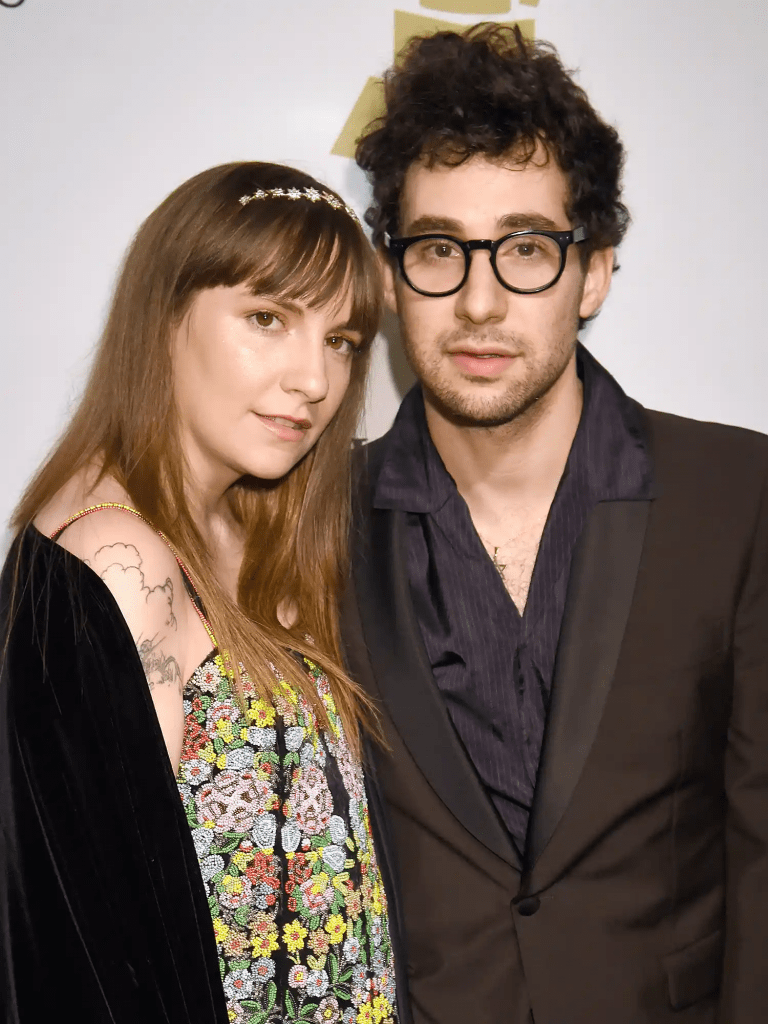
In 2012, Dunham was a first-time showrunner at 25. Antonoff was the lead guitarist of the band Fun, riding the success of their single “We Are Young.” A mutual friend, his sister Rachel Antonoff, a fashion designer, set them up.
On their first date, Dunham writes in Famesick, Antonoff told her he had watched the first episode of Girls. He said: “You’re like a modern Woody Allen, which is the nicest thing I can say to a person.”
They dated for six years. They lived together. They made plans to marry and have children.
Then Dunham’s health collapsed.
What endometriosis did to their relationship
Endometriosis is a condition where tissue similar to the uterine lining grows outside the uterus. It causes severe, often debilitating pain. Dunham had it badly — worse than most doctors expected.
It affected everything. It affected their sex life. It cancelled holidays. It turned ordinary days into medical emergencies.
Two weeks after Dunham had a hysterectomy — a full surgical removal of her uterus — she tried to talk to Antonoff about her growing reliance on pain medication.
His response, she writes, was to walk to the bathroom and “angrily flush all my pills down the toilet.”
Note: This is the memoir’s most-quoted passage. Many early headlines attributed the pill-flushing to Dunham herself. That is incorrect. Dunham wrote that Antonoff flushed them.
The consequence was immediate. Dunham had to call her doctor. She needed a late-night pharmacy run. Without the medication, she risked going into withdrawal overnight from multiple drugs at once.
That fight, she writes, was the worst of their relationship.
She cheated. She admits it.
Toward the end of their relationship, Dunham had an affair with an old school friend.
She calls herself “an adulteress” in the memoir. She does not name the person.
She also writes that Antonoff may have strayed too. “I wasn’t paying attention, but the internet sure was,” she writes — referencing long-running public speculation about Antonoff and musician Lorde. Both Antonoff and Lorde denied those rumours at the time.
Dunham does not blame Antonoff in the book. She is direct about her own choices.
“No one I wrote about who was part of my work life is a villain,” she told People. “It’s just that I had not yet established the tools. I couldn’t always be honest because I didn’t always know what I needed.”
The end
They split in late 2017. The Guardian published a scene from the memoir: the two of them sitting in their shared kitchen, quietly acknowledging what neither wanted to say. Their “obsessive connection had turned to blind devotion.” The blinders were coming off.
Dunham wrote that she muttered: “But what if we still went on dates?” He laughed sadly. “Whatever you want.”
She told The New York Times: “It’s a unique privilege to have every breakup song you love written by your ex. I feel blessed. I was a really late bloomer. That was my first. I felt like you fall in love with someone and then you’re together for the rest of your life. That ending was extremely intense for me.”
Today, Antonoff is married to actress Margaret Qualley (2023). Dunham is married to British musician Luis Felber (2021).
Sources: AOL / The Independent | Yahoo / The Guardian | People / AOL
Adam Driver Threw a Chair and Screamed in Her Face on the Girls Set
This is the section people are talking about the most.
Before Adam Driver became one of the most acclaimed actors of his generation — before Marriage Story, before The Last Duel, before Megalopolis — he was Adam Sackler on Girls.
He played Hannah’s on-again, off-again boyfriend. The character was volatile. Turns out the set had moments of volatility too.
In Famesick, Dunham writes that Driver:
- Threw a chair at the wall next to her
- Screamed in her face
- Punched a hole in the wall of his trailer
She calls him “spectacularly rude.”
She was his boss. She created the show. She hired him.
But she never said anything.
“At the time, I didn’t have the skill to,” she writes. “It never entered my mind to say, ‘I am your boss, you can’t speak to me this way.’ And, at that point in my 20s, I still thought that’s what great male geniuses do: eviscerate you.”
That last line is the most important one. She is not just describing Driver’s behaviour. She is describing a mindset — one she had absorbed from the industry around her — that tolerated and even romanticised male outbursts as a sign of artistic seriousness.
The Mirror US confirmed the memoir’s release and Dunham’s public descriptions of Driver’s behaviour. Adam Driver, his representatives, and Judd Apatow — who produced Girls — had not publicly responded to the claims at the time of publication.
Sources: The Hollywood Reporter | Yahoo / The Guardian | The Mirror US | Yahoo Canada
Rehab at 31: The Klonopin Dependency and the 28-Day Stay
Klonopin is a benzodiazepine. It is prescribed for anxiety and seizures. Used long-term, it creates physical dependency. Coming off it requires medical supervision.
Dunham had been prescribed it for anxiety and OCD since her teenage years. As her health deteriorated and the pressures of Girls piled up, the medication became more than a prescription — it became a coping mechanism.
In April 2018, she checked into rehab.
The facility was a stone manor in the Berkshires. She arrived under a pseudonym: Rose O’Neill, the name of an American illustrator who lost her fortune to burnout and hangers-on — a name Dunham chose deliberately.
She had to hand over her boots at the door.
The 28-day programme was cognitive-behavioural therapy based. Her therapist, Dr Mark, told her the truth. Her situation was not a three-car pile-up. It was a 50-car pile-up.
Chronic illness. Fame. Reproductive trauma from the hysterectomy. The Antonoff breakup. Sexual trauma. Years of unprocessed pain. All stacked on top of each other. All driving her toward medication that had become an escape.
“I was trembling like a little kid,” she recalled of her arrival. The Guardian published excerpts of her account, describing the moment she understood something important: it wasn’t something happening to her. She was the chaos.
She loved rehab. She has said so publicly and says so in the memoir.
“I’ve been through a lot of hard things in my adulthood. Getting off Klonopin was probably the hardest,” she told the Not Skinny But Not Fat podcast. “The way I feel about being sober is the same way I feel about being a vegetarian, which is like, it’s the right thing for me.”
She left the facility after 28 days. Thirty days later, she started writing Famesick.
She is currently nearly eight years sober.
If you or someone you know needs support with substance use, SAMHSA’s free helpline is available 24/7 at 1-800-662-4357. In a mental health crisis, call or text 988.
Sources: Art Threat | A Sober Girls Guide | Primetimer | NYC Today
The Body: Endometriosis, Hysterectomy, and Ehlers-Danlos Syndrome
The physical story running through Famesick is as significant as any of the relationships.
For years, Dunham was in constant pain and doctors didn’t know why.
She had endometriosis — a condition where tissue similar to the uterine lining grows outside the uterus. It caused ovarian cysts and debilitating pain throughout the final seasons of Girls. She describes visiting doctors who didn’t take her seriously, procedures that failed, and a growing sense that her body was working against her.
In 2018, at age 31, she had a total hysterectomy. When doctors opened her up, they found the damage was “worse than anyone had imagined.” A surgeon later removed 37 lesions from her bladder, liver, abdominal wall, and spine. He told her he didn’t know how she had been walking.
The hysterectomy put her into early menopause. It also meant she could not biologically carry a child.
Then came the second diagnosis. In 2019, doctors identified hypermobile Ehlers-Danlos syndrome (hEDS) — a genetic condition affecting connective tissue throughout the body. It causes joint instability, chronic pain, and severe bruising. It had been undiagnosed for most of her life.
She described the experience of living in her body at the height of her career as “towing a wrecked car across town at midnight.”
“Illness, like fame, can make you contract into self because physical pain is one of the most selfish feelings that exists,” she told The New York Times. “All you want is to be out of it.”
Sources: Yahoo Canada — Famesick roundup | OurDailyRead — Guardian interview | World Today Journal
The Jenni Konner Relationship: The Friendship That Ended
Not all the drama in Famesick involves men.
Jenni Konner was assigned to Dunham by HBO as a producing mentor when Girls first went into production. She was 15 years older than Dunham, married with two children. What followed was a decade of intense, complicated female friendship.
Dunham calls it a “platonic love story.” She also describes it as toxic — full of jealousy, manipulation, sulking, clinginess, and eventually, an ugly end.
The reason the memoir took seven years to publish, Dunham writes, is that Konner made one request: “I know how you work, and that you will. But please, just not right away.”
Dunham honoured the request. The book comes out now.
The two women no longer speak. Dunham told People: “No one I wrote about who was part of my work life is a villain. It’s just that I had not yet established the tools.”
Sources: The Hollywood Reporter | People / AOL | OurDailyRead
“Lambs to the Slaughter”: What It Was Like to Be 25 and Famous
Dunham was 25 when Girls premiered on HBO in April 2012.
She had no preparation for what came next. In an interview with The Guardian, she described the experience for herself and her co-stars — Allison Williams, Jemima Kirke, and Zosia Mamet — as being “lambs to the slaughter.”
The criticism was immediate. It was about her body. It was about her ideas. It was about her privilege. The internet was in its most unregulated phase. There were no tools for managing it.
“I am one of the many examples they have of what can happen,” she told The Hollywood Reporter. “And there’s a sense of people learning how much vulnerability is useful and how much is not.”
Her old friend group disappeared. Dinners she wasn’t invited to. Weekends away without her. When they did include her, nobody asked about her life. In one painful scene from the memoir, they prank-called her.
“I got everything I dreamed of — when I had no ability to handle it,” she told The Guardian. It is perhaps the simplest summary of what the whole book is about.
She wrote the memoir’s prologue as a kind of answer to what the decade taught her: “Unlike being sick, when you’re famous, nobody feels sorry for you.”
Sources: The Hollywood Reporter | OurDailyRead — Guardian interview
Lena Dunham Now: Married, Sober, New Projects
After leaving rehab in 2018, Dunham moved to London. The city gave her distance from everything she had been.
In 2021, she married Luis Felber — a British musician known professionally as Attawalpa. The memoir ends before their marriage; Dunham chose not to include that chapter yet.
In 2024, she was diagnosed with Ehlers-Danlos syndrome — confirming the cause of years of mystery pain.
She is nearly eight years sober.
Her most recent creative project is Too Much — a Netflix series she co-created with Felber about emotional recovery and self-discovery. Famesick launches alongside an I Choose Me-style podcast and promotional tour.
She told People that she now feels “excited and grateful to wake up in this world” — something she would have laughed at being told at 22.
Sources: People / AOL | A Sober Girls Guide
Full Timeline: Lena Dunham 2010–2026
| Year | What happened |
|---|---|
| 2010 | Begins writing Girls pilot |
| 2012 | Girls premieres on HBO; meets Jack Antonoff |
| 2012–17 | Relationship with Antonoff; increasing health problems |
| 2014 | First memoir Not That Kind of Girl published |
| 2017 | Hysterectomy at 31; worst fight with Antonoff over flushed pills |
| Late 2017 | Splits from Antonoff; he marries Margaret Qualley in 2023 |
| 2018 | 28-day rehab at Berkshires facility for Klonopin dependency; begins writing Famesick 30 days later |
| 2019 | Diagnosed with Ehlers-Danlos syndrome; moves to London |
| 2021 | Marries Luis Felber |
| 2022 | Girls concludes rerun cycle; Dunham continues writing |
| 2025 | Announces Famesick via Instagram |
| April 14, 2026 | Famesick publishes (Random House) |
Frequently Asked Questions
What is Lena Dunham’s memoir Famesick about?
Famesick covers the decade from 2010 to 2020 — Dunham’s rise to fame on Girls, her six-year relationship with Jack Antonoff, her battles with endometriosis and Ehlers-Danlos syndrome, her Klonopin dependency and 28-day rehab stay, her working relationship with Adam Driver, and the collapse and reconstruction of her personal and professional life.
Did Jack Antonoff flush Lena Dunham’s pills?
Yes — according to Dunham’s memoir. Two weeks after her hysterectomy, she and Antonoff had their worst fight. She writes that he “went to the bathroom and angrily flushed all my pills down the toilet,” forcing an emergency call to her doctor and a late-night pharmacy visit to prevent withdrawal. This is the memoir’s most-misreported passage — some early headlines attributed the flushing to Dunham herself, which is incorrect.
Did Adam Driver really throw a chair at Lena Dunham?
Dunham writes in Famesick that Driver threw a chair at the wall next to her, screamed in her face, and punched a hole in his trailer wall while filming Girls. She writes that she never confronted him because she believed that was what “great male geniuses do: eviscerate you.” Driver and his representatives had not publicly responded to the claims at the time of publication.
Did Lena Dunham cheat on Jack Antonoff?
Yes. She admits in the memoir to having slept with an old school friend toward the end of their relationship. She calls herself “an adulteress” and does not name the person.
When did Lena Dunham go to rehab?
In April 2018, at age 31, Dunham checked into a 28-day cognitive-behavioural therapy programme at a facility in the Berkshires to detox from Klonopin (clonazepam), a benzodiazepine she had become dependent on. She began writing Famesick 30 days after leaving.
Is Lena Dunham sober now?
Yes. She is nearly eight years sober as of 2026. She told the Not Skinny But Not Fat podcast: “The way I feel about being sober is the same way I feel about being a vegetarian, which is like, it’s the right thing for me.”
What is Ehlers-Danlos syndrome?
It is a genetic condition affecting connective tissue throughout the body. It causes joint instability, chronic pain, easy bruising, and skin issues. Dunham was diagnosed with the hypermobile form (hEDS) in 2019, after years of unexplained pain that doctors had failed to identify. It had been affecting her throughout the run of Girls.
This article is based on verified reporting from People magazine, The Hollywood Reporter, The Guardian (as reported by OurDailyRead and Yahoo), The New York Times (as cited by Yahoo and AOL), The Independent/AOL, The Telegraph (as cited by AOL), The Mirror US, Art Threat, A Sober Girls Guide, Primetimer, NYC Today, and World Today Journal. All direct quotes from Lena Dunham are drawn from her People interview (published April 2026), her New York Times interview (April 11, 2026), her Guardian interview, and excerpts from the memoir Famesick as reported across multiple outlets. All allegations regarding Adam Driver’s behaviour are Dunham’s account as reported in the memoir and represent her claims only. Driver’s representatives had not responded to requests for comment at the time of publication. Jack Antonoff’s representatives had also not responded. This article presents all allegations as Dunham’s account, not independently verified fact.
If any content in this article is distressing: call or text 988 (US Suicide and Crisis Lifeline) or contact SAMHSA’s free 24/7 helpline at 1-800-662-4357 for substance use support.